


Before the Breach: Why Proactive Security is Your Key Priority
22Jan
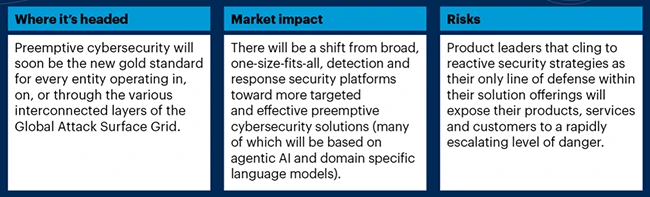
In recent years, cybersecurity has been shifting from reactive defenses (detect & respond) toward preemptive strategies - to anticipate, block, or at least delay attackers before they penetrate deeply.
According to Gartner, preemptive tools like predictive threat intelligence, advanced deception, and automated defenses will account for 50% of security spending by 2030, up from under 5% in 2024.
Cyber deception stands out as one of the most promising tactics in this shift. By creating traps, and fake assets, deception-based tools grab attacker activity early, force them to reveal tactics, and reduce the attacker’s dwell time inside networks.
What We’re Seeing: The Rise of Preemptive Cybersecurity
Some of the major trends Gartner highlights:
Predictive threat intelligence and automated moving target defenses to reduce attack surfaces and blur attackers’ ability to plan.
The move from catching intrusions after the fact to detecting them during reconnaissance or lateral movement,so the damage can be stopped early.
Adoption of more specialized tools tailored for different sectors (cloud-native apps, ICS/OT, AI pipelines, etc.), because a one-size-fits-all strategy won’t be able to keep up.
The potential of “Autonomous Cyber Immune Systems (ACIS)” , dynamic, adaptive frameworks that can respond automatically to threats with minimal human intervention.
Labyrinth Platform Matches the Need
Labyrinth Platform is one of the tools emerging to address exactly these needs. Its platform offers features aligned with Gartner’s predictions and more. Here’s how it fits in and where it shines:
Key Capabilities
Deception‐based intrusion detection: The platform sows “fake” assets, applications, and vulnerabilities inside a network. These traps tempt attackers, which allows defenders to detect malicious activity before critical systems are compromised.
Silent, low-noise alerting: Labyrinth emphasizes minimal false positives, fewer “digital noise” alerts. The deception tools are largely passive until touched , meaning fewer distractions and more reliable signals.
Rapid response and visibility: Once a deception is triggered, Labyrinth collects threat indicators, threat source info, tactics used by attacker, etc. It integrates with incident response and threat prevention tooling to isolate compromised hosts and raise alerts.
Insight into attacker behavior: It doesn’t only detect “something happened” , it provides information about how attackers are operating (reconnaissance paths, credential abuse, lateral movement) so defenders can better understand their adversary.
What Makes Labyrinth Particularly Relevant
Given the move toward preemptive cybersecurity, several characteristics of Labyrinth give it strong relevance:
Early Stage Detection
Traditional defenses often wake up only after attackers have breached perimeter defenses or exploited known weaknesses. Labyrinth’s deception technology triggers earlier , during reconnaissance, mapping, or lateral movement. That means the “dwell time” (how long attackers remain undetected) can be greatly reduced.
Reduced Noise / False Alerts
One of the major pains in cybersecurity operations is sifting through tons of alerts, many of them false positives. Since deception is largely passive until “touched,” it can significantly reduce alert fatigue , something Gartner and many CISOs are calling for. Labyrinth claims less than 1% false positives.
Fit for Heterogeneous Environments
The platforms that will succeed are those that can adapt to different network topologies, cloud/on-prem mixes, web apps, etc. Labyrinth’s platform is designed for both cloud and on-premises services and seems built to mimic real applications and services to fool attackers.
Minimal Operational Overhead
Deception deployed incorrectly can itself become a maintenance burden. Labyrinth emphasizes simple installation and configuration, real-time visibility, and no huge data storage or enormous noise. That matches what many organizations want: defensive capability without the overhead.
Challenges & Considerations
While deception tools like Labyrinth are powerful, there are some caveats to keep in mind:
Integration & Visibility: You need the platform to feed into your wider monitoring stack (SIEM, SOAR, etc.) so deception triggers translate into actionable alerts. If these alerts get lost in operational noise, value decreases.
Maintenance of Deception Content: Fake assets and vulnerabilities must look realistic. If they are clearly fake, attackers may ignore or avoid them. Crafting realistic traps takes some effort.
Balancing Deception vs. Disruption: Deception must be done carefully , if traps accidentally interfere with real operations, or leak confusing signals, they can cause operational risk.
Adversary Awareness: As deception becomes more common, attackers may try to test whether assets are real or traps. The arms race continues: your deception must evolve to avoid detection.
Conclusion: A Preemptive Future + Deception as a Core Strategy
Gartner’s forecast is clear: preemptive cybersecurity isn’t just a niche trend , it’s rapidly becoming mainstream. By 2030, a large proportion of security budgets will go toward technologies that anticipate and stop attacks before damage is done.
Within this landscape, preemptive tools like Labyrinth are central for your cyber strategy. They:
Provide early detection and visibility
Reduce attacker dwell time
Give defenders insight into attacker methods
Potentially lighten the load of false positives
For organizations evaluating how to get ahead of threats , not just respond to them , platforms like Labyrinth offer a compelling path forward. If you’re designing a cybersecurity roadmap for the next 2–5 years, it's wise to include deception as part of a layered, proactive strategy.
We invite you to try our solution in your own environment. Deployment is straightforward, and our team will support you throughout the entire process.
If you have any questions or need help, feel free to reach out at [email protected], we’re always happy to assist.